Defense Innovation - Executive Summary
When identifying topics for reports, we look for where inevitability will collide with complexity to generate investor misunderstanding and therefore, exploitable opportunity. With no theme has this opportunity struck us as clearer and more compelling than defense spending. We began researching and writing this report roughly a month before the Trump administration, alongside Israel, decimated Iranian leadership and set off a wider conflict across the Middle East. The war will likely prove an accelerant for the dynamic we saw prior to February 28th: accelerating global defense spending is poised to run headlong into accelerating defense innovation with market participants underestimating the breadth of implications. We don’t intend this report to get bogged down in the global geopolitical landscape. The goal is to present an actionable roadmap to investing in the longer-term disruption of the defense spending status quo.
Through the first two months of 2026, one declaration defined the geopolitical dialogue: “The post-1945 world order is dead.” Canada’s Mark Carney declared it at Davos. Germany’s Friedrich Merz and France’s Emmanuel Macron then echoed Carney at the Munich Security Conference. To quote Macron: “Europe’s old security structures tied to the previous world order don't exist…Europe must prepare for war.”
Yet, while Carney’s Davos speech in particular has been viewed as a “turning point” moment, global rearmament has been ongoing for years. Global defense spending has now increased for 10 consecutive years. In 2024, global defense spending hit $2.7 trillion, a 9% jump from 2023, “the steepest increase since the Cold War,” according to the Stockholm International Peace Research Institute. Every region on earth is contributing to the spending increases. Between 2021 and 2025, European NATO members boosted defense budgets by roughly 41%. In 2024, military expenditures in the Middle East reached an estimated $243 billion, an increase of 15% from 2023 and 19% more than in 2015. China has increased its official defense budget by 7% or more for four consecutive years. And for fiscal-year 2026, US defense spending is set to increase by 13% versus FY2025. The Trump Administration is seeking a further roughly 50% increase to $1.5 trillion for 2027.
Yet, the to-date increases belie how much more room remains for defense spending growth. Military expenditures as a percentage of global GDP still sits at nearly half the Cold War average (chart below). Continued defense spending growth appears inevitable. As the UN projected in September of last year: “If current trends persist, global military spending could reach $6.6 trillion by 2035.” Obviously, that was before Carney’s speech in Davos and the Trump administration’s actions in Venezuela and Iran—i.e., trend disrupting developments.

Source: World Bank Group
Since launching Sage Road Research in July, we’ve recommended increasing exposure to defense stocks. That was clearly a widely held conviction in 2025. As of writing this, the S&P Aerospace & Defense Select Industry Index had delivered a one-year return exceeding 74%. European defense stock returns have been even stronger with a Goldman Sachs basket of European defense companies surging 90% in 2025 followed by another 21% gain in January. Chinese defense companies also saw lofty gains, with the GS China Defense Index outperforming the MSCI Asia Pacific Index by roughly 50 percentage points in 2025.
Obviously, such rapid share-price gains raise valuation concerns. For one reference point, the Bloomberg chart below shows the extreme divergence that has formed between European defense stock valuations and forward earnings expectations. Market-participant valuation concerns have been evident in defense stock-price action YTD with the news cycle increasingly triggering either violent downward price swings in the case of “good news” or muted reactions in the case of “bad news”. For one, European defense stocks dipped as much as 4.2% after Donald Trump declared at Davos in January that he wouldn’t use “excessive force” to seize Greenland. For another, stocks of US defense primes—i.e., top-tier contractors—fell roughly 3% on average after Trump issued an executive order threatening to prohibit defense contractors from buybacks or dividends. Even in the early weeks of the US’ attack on Iran, the iShares US Aerospace & Defense ETF as well as the State Street SPDR S&P Aerospace & Defense ETF were flat to down, suggesting markets considered the increasing demand for equipment and munitions that could result from the war was already “priced in”.

Which bring us to the second part of our defense-innovation conviction: complexity. To date, we’ve seen much the same dynamic at play with the defense-spending trade as we’ve seen with the genAI trade—investor oversimplification, fixating on the most-obvious “pure-play” stakeholders while neglecting the breadth of potential disruption to come. Given the current defense-spending status quo, there’s good reason for that fixation. Just consider the US. Between 2020 and 2024, defense contractors received $2.4 trillion from the Pentagon, approximately 54% of the department’s discretionary spending of $4.4 trillion over that period, according to a Brown University study. And $771 billion worth of those contracts went to just five primes: Lockheed Martin, RTX, Boeing, General Dynamics, and Northrop Grumman.
However, the status quo is unlikely the path for policymakers to achieve the two defense-spending priorities that have emerged ubiquitous across the globe: “sovereignty” and “modernization”. The chart below is one of the most striking we came across researching this report. It illustrates the deep dependence of current US air-launched armament supply chains on China. In a world increasingly defined by great-power politics, how can US defense systems remain reliant on the US’ preeminent great-power adversary? In a fracturing world, it’s a question increasingly influencing defense spending decisions across the globe. As CNBC recapped after the Singapore Airshow in February:
With geopolitical uncertainty on the rise, defense buyers say they are prioritizing sovereignty, from local production and co‑development to owning the software and intellectual property that run their systems. Industry leaders say that control over hardware, software and supply chains is now a central factor in procurement decisions.

Source: Govini via Cantos
The sovereignty priority is intertwined with the modernization priority. Defense innovation is accelerating across every facet of modern conflict, from systems infrastructure, communications, and intelligence technology to cybersecurity, space, advanced manufacturing, and armaments and battlefield technologies. This is already reshaping the defense contractor landscape. For one, software has been slowly eating the warfare world, to paraphrase Marc Andreessen. Between 2016 and 2026, the DoW’s IT budget ballooned by roughly 74%, from $37 billion to greater than $66 billion. This is one key driver of the rise of the defense-tech startup ecosystem, which has grown far larger and more diverse than just the well-known names like Palantir, Anduril, and SpaceX. For most of this century, defense-related investments were a rounding error for venture capitalists. That took a turn starting in 2018 and the pace of investment has gained momentum since (chart below). Over the past decade, venture capital investments of more than $10 million in defense-focused companies have grown five times in value and deal count has increased eightfold, according to Bain. The impact of that investment is already apparent on the battlefield. As Bessemer Venture Partners has noted, more than 30 US startups had deployed products in Ukraine as of 2024.

Source: JP Morgan
In their 2025 book “The Arsenal of Democracy,” Eyck Freymann and Harry Halem made a key point about the war in Ukraine and what it says about the dynamics that will reshape global defense spending moving forward.
The battlefield in Ukraine has become a sandbox of innovation. Whichever side has enjoyed the adaptive advantage at any given time has been able to impose asymmetric costs on the other...It is clear that the pace of innovation in defense technology is accelerating. For the last seven decades, the United States has deterred conflict with other great powers through the combination of nuclear weapons and a dominant conventional force. To preserve deterrence against them and other hostile powers over the next decade and beyond, the United States will have to both modernize its force and find innovative ways to integrate new technologies with existing platforms.
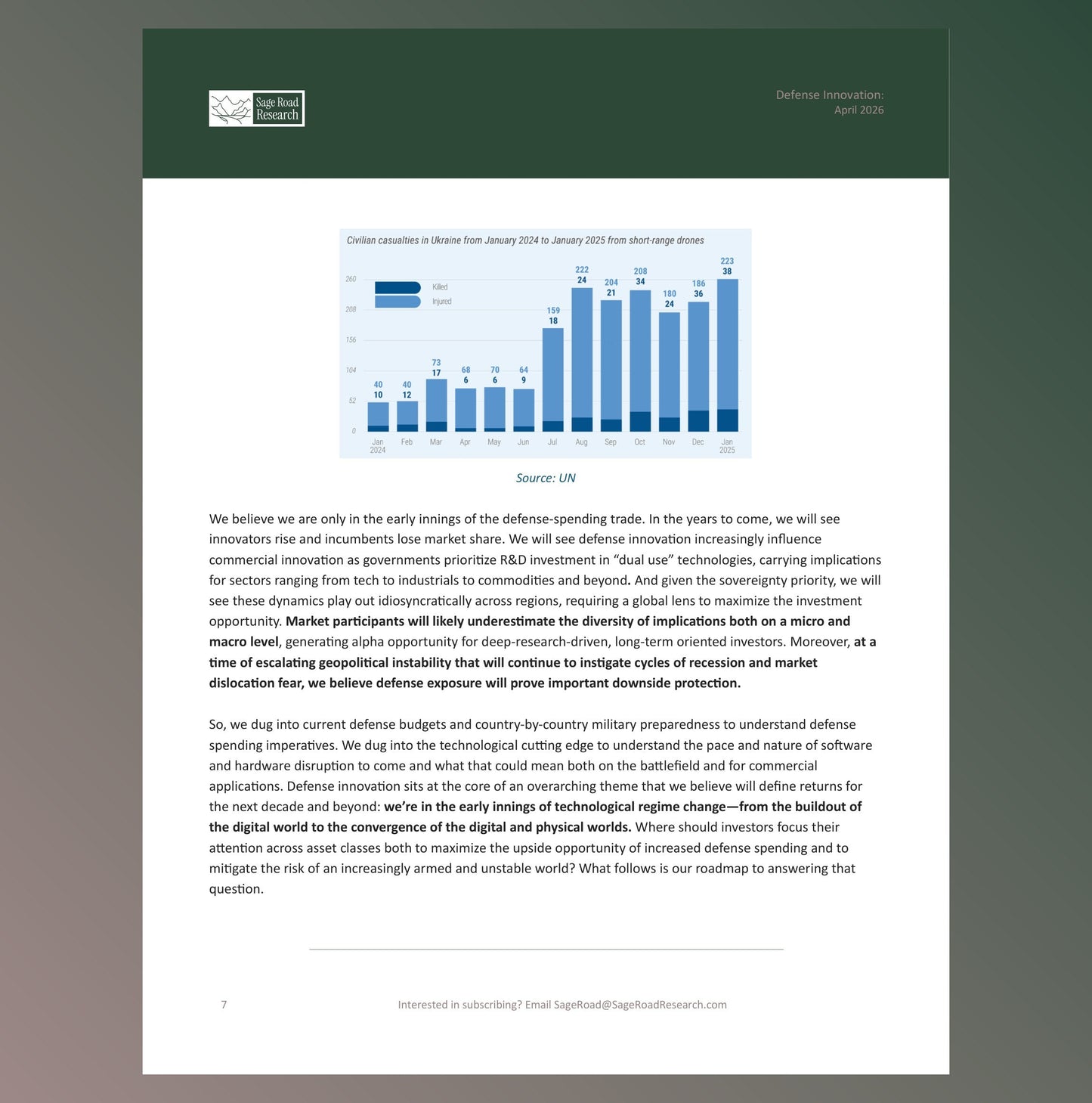
This applies for all global governments at a time of increasing defense innovation. The self-perpetuating cycle is clear: new offensive capabilities beget new defensive capabilities, which then instigate new offensive capabilities. AI is poised to accelerate that cycle, both in how it transforms logistics management and how it enables automation on and off the battlefield. One stat that reflects the defense-spending dynamism likely to result from the AI revolution: personnel expenditures are the single biggest line item for most defense budgets, accounting for over 60% of military expenditures in developing countries and just under 40% for NATO countries, according to the UN. Via automation, AI promises to progressively reduce the human cost of conflict, at least in terms of personnel expenditures, enabling governments to shift budgets towards technology and away from people. Again, glimpses of this potential are already apparent in Ukraine where “drones with autonomous capabilities are now part of the war’s bloody and destructive routine,” as The New York Times reported in January.

Source: UN
We believe we are only in the early innings of the defense-spending trade. In the years to come, we will see innovators rise and incumbents lose market share. We will see defense innovation increasingly influence commercial innovation as governments prioritize R&D investment in “dual use” technologies, carrying implications for sectors ranging from tech to industrials to commodities and beyond. And given the sovereignty priority, we will see these dynamics play out idiosyncratically across regions, requiring a global lens to maximize the investment opportunity. Market participants will likely underestimate the diversity of implications both on a micro and macro level, generating alpha opportunity for deep-research-driven, long-term oriented investors. Moreover, at a time of escalating geopolitical instability that will continue to instigate cycles of recession and market dislocation fear, we believe defense exposure will prove important downside protection.
So, we dug into current defense budgets and country-by-country military preparedness to understand defense spending imperatives. We dug into the technological cutting edge to understand the pace and nature of software and hardware disruption to come and what that could mean both on the battlefield and for commercial applications. Defense innovation sits at the core of an overarching theme that we believe will define returns for the next decade and beyond: we’re in the early innings of technological regime change—from the buildout of the digital world to the convergence of the digital and physical worlds. Where should investors focus their attention across asset classes both to maximize the upside opportunity of increased defense spending and to mitigate the risk of an increasingly armed and unstable world? What follows is our roadmap to answering that question.